The short answer
Microplastics are everywhere — and they reach the brain. These particles are small enough to cross the blood-brain barrier, and researchers studying treatment-resistant tinnitus have reported high microplastic accumulation in brainstem tissue alongside low GABA. The proposed chain: microplastics trigger neuroinflammation, that inflammation burns through GABA, and low GABA lets the brainstem's fusiform cells misfire into ringing. You can't avoid microplastics entirely, but research suggests you can help your body reduce the inflammation and clear the particles.
A decade ago, "microplastics" was an environmental headline about oceans and fish. Today it's a human-health story — and one that reaches somewhere surprising: the brain. For anyone living with chronic tinnitus, the connection is worth understanding, because it links an everyday exposure most of us never think about to the ringing that so many people are told has "no known cause."
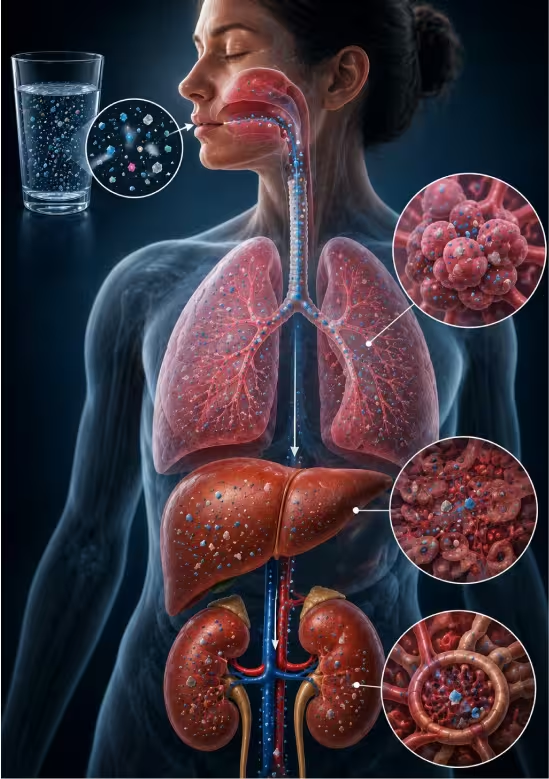
Just how unavoidable are they?
Microplastics are the tiny plastic particles shed by a world built from plastic. They're in bottled water — and tap water too. They're in tea bags, coffee pods, seafood, table salt and produce. Even organic food isn't exempt, because the particles have already worked their way into the soil that grows it. There is, quite simply, nowhere on the planet you can go to escape them entirely. Every day, without noticing, most people inhale, drink and eat them.
Over time, they accumulate — in the lungs, the liver, the kidneys. And, most relevant here, in the brain.
The blood-brain barrier isn't a perfect shield
Your brain has a protective gatekeeper called the blood-brain barrier, designed to keep harmful substances out. But microplastic particles can be small enough to slip right through it. Once inside, the concern is not that they sit there harmlessly. Researchers studying patients with severe, long-standing tinnitus have described a striking pattern: unusually high microplastic accumulation in brainstem tissue, paired with unusually low GABA in the auditory processing region.
The proposed chain of events
Put those observations together and a mechanism emerges — one that connects an environmental particle to a sound inside your head:
- Accumulation. Microplastics build up in the brainstem over years of everyday exposure.
- Inflammation. Rather than sitting inert, they appear to trigger a specific inflammatory response in the surrounding tissue — neuroinflammation.
- GABA depletion. That ongoing inflammation burns through the brain's GABA reserves — the very neurotransmitter that keeps the fusiform cells calm.
- Misfiring. With the GABA "brake" weakened, the fusiform cells lose their restraint and start generating phantom signals — the ringing.
It's an elegant explanation because it ties together things that otherwise seem unrelated: why tinnitus has become so common, why it isn't strictly about age or noise exposure, and why it so often resists ear-focused treatment.
The hopeful part: it may be reversible support
Here is where the story turns constructive. You cannot stop microplastics from entering your body — that ship has sailed for all of us. But the research points to two things you can influence:
- Reduce the inflammation the particles cause in the brainstem, which slows the ongoing GABA loss. Anti-inflammatory and antioxidant compounds — Ginkgo Biloba's flavonoids and terpenoids, zinc, taurine — are studied for exactly this kind of protective role in neural and auditory tissue.
- Help clear the particles. This is the genuinely clever part. Research published in Environmental Science & Technology has shown that certain Lactobacillus probiotic strains can bind microplastic particles in the gut and help escort them out of the body before they're reabsorbed.

In other words, "detox" here isn't a vague wellness slogan — it describes a specific, researched process: bind the particles, calm the inflammation, and give GABA a chance to recover.
Sensible everyday steps, too
None of this replaces basic exposure reduction, which is worth doing regardless: favor filtered tap water over bottled, cut back on plastic food packaging and single-use pods, avoid heating food in plastic, and choose loose-leaf tea over plastic-containing bags. These won't undo years of accumulation on their own, but they lower the daily inflow — a reasonable complement to anything you do to support clearance.